Two trucks can pull into a testing location on the same day and need completely different emissions tests. One may need a quick connection to its onboard diagnostic system. Another may need a smoke opacity test plus a visual inspection. A third may require only the visual portion. Under CARB Clean Truck Check, the correct California truck emissions test depends mainly on the engine's fuel type, engine model year, and whether the engine is equipped with an eligible onboard diagnostic system, or OBD. CARB specifically advises owners to check the engine emissions control label because the engine model year can differ from the vehicle model year. That distinction matters. Looking at "2013 truck" on registration paperwork and automatically assuming OBD can point you toward the wrong test. Here is how OBD scans, diesel opacity testing, and visual inspections fit into California's current heavy-duty emissions program.
Which Trucks Are Covered by California Clean Truck Check?
Before figuring out which test a truck needs, first determine whether Clean Truck Check applies to the vehicle at all. CARB says the program covers nearly all diesel and alternative-fuel heavy-duty trucks, buses, and other vehicles with a GVWR over 14,000 pounds that operate on California public roads and highways. That includes commercial vehicles, private vehicles, hybrids, government vehicles, and qualifying trucks registered outside California. So an out-of-state truck California emissions test requirement is entirely possible. A truck does not become exempt simply because its license plate comes from Nevada, Arizona, Texas, Oregon, or another state. Some vehicles are exempt, and certain categories follow different compliance schedules. CARB maintains specific guidance for exemptions, agricultural vehicles, motorhomes, and other special cases. The important point here is that once a vehicle is subject to the program, its required testing method depends on the engine and emissions system rather than where the carrier is headquartered.
OBD vs. Opacity Testing: What Is the Difference?
The simplest way to understand OBD vs. opacity testing is to look at what each test is actually examining. An OBD emissions test communicates electronically with the engine's diagnostic system. It checks information the vehicle already collects about the performance of its emissions-control systems. A smoke opacity test, by contrast, measures diesel exhaust smoke. SAE defines opacity as the percentage of light prevented from reaching a detector as it passes through smoke. Clean Truck Check uses the SAE J1667 snap-acceleration procedure for applicable non-OBD diesel engines. But opacity is only part of the non-OBD diesel inspection. Affected non-OBD diesel vehicles must also receive a Vehicle Emissions Control Equipment Inspection, which visually checks required emissions-control components. That gives Clean Truck Check several possible testing combinations depending on the engine.
What Does a CARB OBD Test Check?
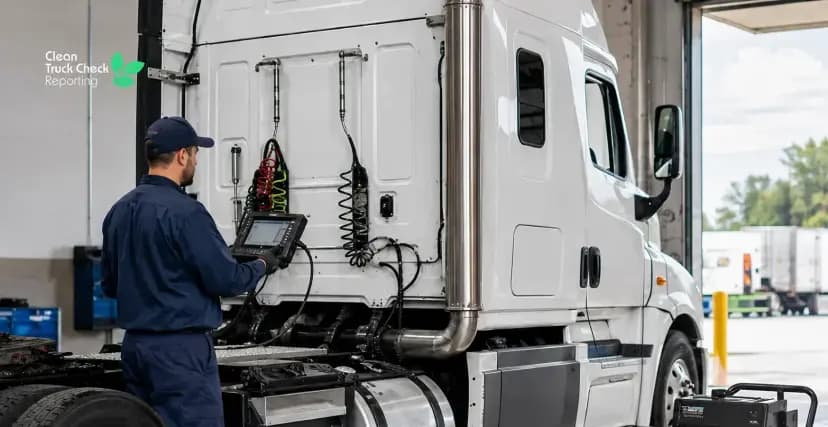
Think of OBD as the truck reporting on its own emissions system. For affected engines, a CARB-certified testing device connects with the onboard computer and retrieves emissions-related information. CARB identifies core elements such as Malfunction Indicator Light status, Diagnostic Trouble Codes, monitor readiness, operation since codes were cleared, and permanent diagnostic trouble codes.
This allows Clean Truck Check to look beyond whether the dashboard warning light happens to be illuminated at the moment of testing. For example, the OBD system can show whether emissions-related monitors have completed their diagnostic checks. If codes were recently cleared, the vehicle may not have operated long enough for those monitors to become ready again. In that situation, the vehicle may be considered "not ready" and unable to pass the compliance test yet. The CARB OBD test must use a testing device certified by CARB for Clean Truck Check. CARB warns that using an OBD device that is not certified for the program results in an unsuccessful compliance test.
What Does a Smoke Opacity Test Check?
A diesel smoke test looks at the visible smoke in the exhaust rather than electronically reading the engine computer. For applicable vehicles, the tester uses an SAE J1667-compatible smoke meter. The device measures how much light is blocked by diesel exhaust smoke during the prescribed snap-acceleration procedure. Under Clean Truck Check, this applies primarily to older diesel engines that do not fall into the program's OBD category.
The test does not stand alone. A 2012-or-older non-OBD diesel engine generally requires both diesel opacity testing and the Vehicle Emissions Control Equipment Inspection. The visual portion examines required emissions-control equipment based on the vehicle and engine configuration. There is an important exception: older non-OBD alternative-fuel engines do not undergo the smoke opacity portion. CARB currently requires those vehicles to complete the visual inspection only.
Which Test Does Your Engine Model Year Require?
This is where the differences become much easier to see. CARB divides the normal testing categories according to engine model year, fuel type, and OBD status. Current guidance uses 2013 as the major OBD dividing point for diesel engines and 2018 for alternative-fuel engines.
Engine category | Required Clean Truck Check test |
|---|---|
2013 and newer diesel engines with OBD | OBD scan |
2012 and older non-OBD diesel engines | Smoke opacity test + visual inspection |
2018 and newer alternative-fuel engines with OBD | OBD scan |
2017 and older non-OBD alternative-fuel engines | Visual inspection only |
Heavy-duty vehicles equipped with off-road engines | Opacity test + visual inspection regardless of engine model year |
This is why asking "Which emissions test does my truck need?" cannot always be answered from the truck's vehicle year alone. A 2013 cutoff does not universally apply to every Clean Truck Check vehicle. For diesel engines, 2013 and newer engines equipped with OBD generally receive the electronic test. Alternative-fuel engines use the later 2018-and-newer OBD category. Older alternative-fuel engines are treated differently again because they generally receive the visual inspection without an opacity test. There is also a special rule for off-road engines. Some heavy-duty vehicles operating on California public roads are powered by engines originally certified for off-road use. CARB says there are currently no OBD requirements for these off-road engines under Clean Truck Check, so covered vehicles using them must complete an opacity and visual inspection regardless of engine model year. That means a newer calendar year does not automatically equal an OBD scan.
Why the Engine Emissions Label Matters
A truck's registration paperwork tells you plenty about the vehicle. It does not necessarily tell you which Clean Truck Check test the engine requires. CARB specifically tells vehicle owners to refer to the engine's emissions control label, or ECL, when determining the correct testing category. Why? Because the engine model year and vehicle model year are not always identical. CARB notes that many vehicles have an engine model year that is one year older than the vehicle model year.
Imagine a truck sold as a 2013 model but equipped with a 2012 diesel engine. Looking only at the vehicle year could lead someone to assume it requires a CARB OBD test. The engine information may instead place it in the non-OBD category requiring opacity and visual testing. The engine emissions control label helps establish information such as the engine model year, fuel type, and emissions certification details. That makes it a better starting point for selecting the appropriate CARB emissions test than simply guessing from the truck's registration year. This is especially useful for older equipment, trucks that have changed ownership, or vehicles where the engine and chassis years differ.
How Often Is Clean Truck Check Testing Required?
Knowing the right test is only half of the compliance picture. The other question is when that test must be completed. In 2026, almost all vehicles subject to regular Clean Truck Check testing are on a semi-annual emissions testing schedule. In other words, most covered commercial vehicles currently require a passing emissions compliance test twice per year. Agricultural vehicles that meet CARB's definition and qualifying California-registered motorhomes used for recreational or emergency occupancy generally remain on an annual schedule.
Another major change begins in October 2027. At that point, OBD-equipped vehicles generally move to four tests per year. CARB specifically notes that this increase does not apply to qualifying agricultural vehicles or non-commercial motorhomes, which continue to follow annual testing. So "quarterly Clean Truck Check testing" should not be treated as a universal requirement for every truck. The testing method and testing frequency are separate questions. An older non-OBD diesel may continue receiving opacity and visual testing under its applicable schedule, while a qualifying OBD-equipped truck will eventually move to four OBD compliance tests per year. Owners should use the deadlines displayed in their CTC-VIS account rather than calculating future testing dates from memory. CARB also allows credentialed testers to submit a passing test up to 90 days before the vehicle's compliance deadline. Testing during that window can leave time for repairs and retesting if the vehicle does not initially pass.
Who Can Perform and Submit the Test?
Clean Truck Check testing cannot simply be completed with any scan tool or smoke meter.
CARB requires emissions compliance testing to be performed by a CARB-credentialed tester holding a current credential, subject to limited program provisions such as certain certified telematics submissions. For an OBD compliance test, the tester must use a CARB-certified OBD testing device. CARB maintains a list of devices accepted for the program and states that an uncertified OBD device will produce an unsuccessful compliance test.
For applicable non-OBD diesel testing, the tester needs an SAE J1667-compatible smoke meter as well as the information necessary to complete the Vehicle Emissions Control Equipment Inspection. The tester is responsible for submitting the Clean Truck Check test results to CARB. Vehicle owners do not separately upload the compliance test themselves. They can, and should, check CTC-VIS afterward to verify that the results appear correctly.
That last check is worth doing. Using the wrong testing method, testing an OBD vehicle with a device that CARB has not certified, or completing an opacity test without the required visual inspection can prevent the vehicle from successfully demonstrating compliance.
The goal is not simply to say the truck was "emissions tested." It must receive the specific Clean Truck Check test required for that engine category, with the results properly submitted to CARB.
Choosing the right California truck emissions test becomes much simpler once you stop looking only at the year printed on the truck's registration. For diesel engines, 2013-and-newer OBD-equipped engines generally receive an OBD emissions test, while 2012-and-older non-OBD diesel engines generally require a smoke opacity test plus a visual emissions-control equipment inspection. For alternative-fuel engines, the OBD dividing point is later: 2018-and-newer OBD-equipped engines receive the electronic scan, while 2017-and-older non-OBD engines generally require the visual inspection only. Covered vehicles equipped with off-road engines currently require opacity and visual testing regardless of engine model year.
The easiest mistake is assuming the truck's vehicle model year automatically tells you which category applies. Instead, check the engine emissions control label, confirm the engine model year and fuel type, and review the vehicle's deadline in CTC-VIS. CARB specifically recommends using the engine label because engine and vehicle model years can differ.
When the category is still unclear, confirm it with a CARB-credentialed tester before the compliance window starts closing. With Clean Truck Check, the question is not simply whether your truck needs testing. It is whether the right test reaches CARB by the right deadline.