There is no single clean truck. Check the deadline that every carrier can circle on the calendar. One truck may be due in March, another in October, and a third may follow a completely different schedule because of its registration history. For fleets with vehicles registered in multiple states, keeping track of those dates can quickly become more complicated than simply remembering “test twice a year.”
The CARB Clean Truck Check program generally applies to diesel and alternative-fuel heavy-duty vehicles with a gross vehicle weight rating over 14,000 pounds that operate on California public roads. That includes many commercial trucks, buses, government vehicles, hybrids, and vehicles registered outside California. Covered vehicles must be reported in CTC-VIS, pay the applicable annual compliance fee, and submit required passing emissions tests.
The important part for carriers is that Clean Truck Check deadlines are vehicle-specific. Depending on the vehicle, CARB may determine the schedule from its California DMV registration expiration date, the last numerical digit of its VIN, its previous California registration history, or its vehicle category. And when there is any doubt, the deadline displayed in CTC-VIS is the date that matters for compliance.
Which Carriers Must Follow Clean Truck Check Deadlines?
Clean Truck Check is not limited to trucking companies based in California. CARB states that nearly all diesel and alternative-fuel heavy-duty vehicles over 14,000 pounds GVWR that operate on California public roads and highways are subject to the program. Covered vehicles can include commercial trucks, buses, hybrid vehicles, privately owned vehicles, government fleets, and vehicles registered outside the state. That means an Arizona, Nevada, Oregon, Texas, or other out-of-state carrier can still face California truck emissions testing requirements when operating covered equipment in California. Registration location alone does not create an exemption.
There are, however, specific exclusions. CARB lists categories such as zero-emission vehicles, military tactical vehicles, qualifying emergency vehicles, historical vehicles, out-of-state motorhomes, vehicles operating under certain experimental permits, and certain other limited categories as outside the program. Some covered vehicles also follow a different testing frequency. Qualifying agricultural vehicles and California-registered motorhomes used for recreational or emergency occupancy generally follow an annual testing schedule rather than the normal semi-annual schedule. Commercial-use motorhomes follow the regular semi-annual requirements. So before looking for a date, the first question is whether the vehicle is covered and which compliance category applies.
How Are Clean Truck Check Deadlines Determined?
For most affected commercial vehicles in 2026, Clean Truck Check compliance is demonstrated every six months. How CARB assigns those six-month periods depends largely on how the vehicle is registered. California-registered vehicles generally use their California DMV registration expiration schedule. Many vehicles registered outside California instead use the last numerical digit of their VIN. CARB emphasizes that these tables provide the schedule framework, but the dates shown in the individual vehicle's CTC-VIS account are used to determine its actual compliance status.
Deadlines for California-Registered Trucks
For a California-registered truck, the initial compliance schedule is linked to the vehicle's DMV registration expiration date, with another testing deadline six months later.
The simplified schedule looks like this:
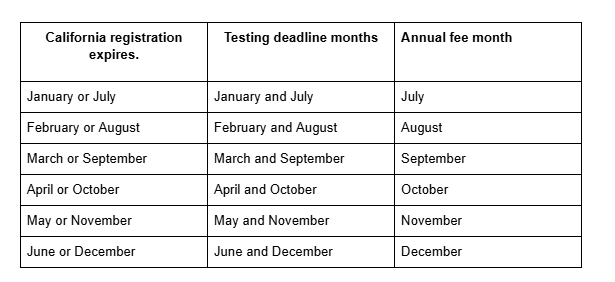
The annual fee is due once during the compliance year, while a truck on the semi-annual schedule has two testing periods. There is also an important rule for fleets whose DMV dates change later. CARB's FAQ explains that once a Clean Truck Check compliance deadline has been linked to a California DMV registration expiration date, that deadline remains assigned even if DMV subsequently changes the registration expiration date.
The same principle applies to vehicles that were historically registered with California DMV. If a truck was previously California-registered and is now registered in another state, CARB says it generally continues using its California-registration-based Clean Truck Check schedule rather than switching automatically to the VIN schedule used for most other out-of-state vehicles. That makes registration history particularly important when purchasing, transferring, or relocating equipment.
Deadlines for Out-of-State and Exempt-Plated Trucks
For most trucks that are registered outside California and have not previously been registered with California DMV, Clean Truck Check deadlines are based on the last numerical digit of the VIN. The same VIN-based schedule applies to certain DMV-exempt state and local government vehicles and federal government vehicles.
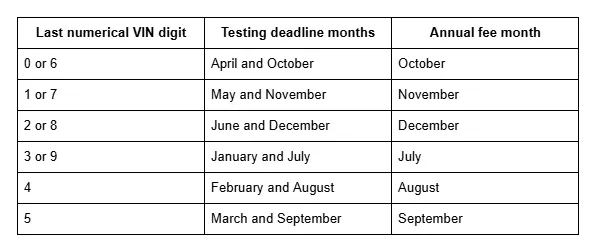
For example, an out-of-state truck with a VIN ending in 6 generally has testing deadlines in April and October, with its annual fee associated with the October compliance deadline. A VIN ending in 1 generally points to May and November testing deadlines, with the annual fee due in November. These are useful planning dates, especially for fleets sending equipment into California periodically. But carriers should not determine compliance from the VIN table alone. CARB specifically directs vehicle owners to use the deadlines listed in CTC-VIS.
What Must Be Completed by the Compliance Deadline?
Meeting a CARB compliance deadline involves more than simply getting a truck tested. For a covered vehicle to demonstrate compliance, several parts of the Clean Truck Check program may need to be current at the same time. The vehicle should be correctly reported in CTC-VIS, the applicable annual compliance fee must be paid when due, required passing emissions results must be submitted, and outstanding enforcement violations must be cleared. Vehicle and ownership information should also remain accurate in the system. The annual fee and emissions test should not be viewed as unrelated programs.
They are different parts of the same Clean Truck Check compliance framework. For most covered commercial trucks in 2026, testing is required twice each year, while the Clean Truck Check annual fee is paid once per compliance year. CARB states that the annual fee is due on the first designated compliance deadline of the vehicle's compliance year. That distinction matters when a truck has two testing dates on the calendar. A second emissions-testing deadline does not automatically mean a second annual fee is due. The easiest way to avoid confusion is to review the individual vehicle record in CTC-VIS rather than trying to recreate the entire schedule manually. You Can Check Your USDOT Number and Find your carrier information and see what you need to know about California Clean Truck Check compliance.
How Early Can a Truck Complete Its Emissions Test?
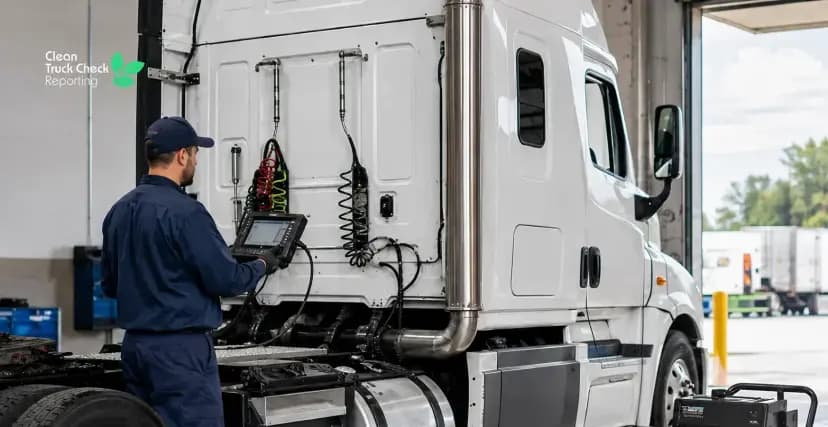
Carriers do not have to wait until the deadline month to begin California truck emissions testing. CARB allows a passing emissions compliance test to be submitted up to 90 days before the vehicle's compliance deadline. Testing must generally be performed by a CARB-credentialed tester using the applicable CARB-certified testing equipment. That 90-day window can be useful operationally. Waiting until the final few days leaves very little room if the truck fails, needs repairs, must be retested, or if information does not appear correctly in CTC-VIS. Testing earlier in the allowed window gives the fleet time to address those issues before the compliance date arrives. CARB also helps fleets keep track of upcoming obligations through CTC-VIS. At the beginning of each month, the system sends an account summary showing vehicles with compliance deadlines during the next 90 days as well as open enforcement actions. The tester handles submission of the required test results, but the carrier should still confirm that the Clean Truck Check test results appear correctly in CTC-VIS.
CARB's FAQ states that accepted testing must be submitted by a credentialed tester using the appropriate testing device. Some OBD results can be submitted electronically through approved systems, while non-OBD testing results are submitted through the tester's CTC-VIS account.
One thing carriers should not do is test far ahead simply because the vehicle is available. CARB permits passing results to be submitted no more than 90 days before the deadline. A test performed outside the applicable window should not be assumed to satisfy the next periodic requirement.
How Often Will Clean Truck Check Testing Be Required?
The Clean Truck Check testing frequency is one area where dates matter because the program changes again in 2027. For 2026, most affected commercial vehicles remain on semi-annual emissions testing, meaning they generally demonstrate compliance every six months. Agricultural vehicles meeting CARB's definition and qualifying California-registered non-commercial motorhomes generally remain on an annual testing schedule. Then another change arrives on October 1, 2027. Beginning at that point, vehicles equipped with qualifying on-board diagnostic systems generally move from two tests per year to four tests per year. CARB's current guidance describes this as applying only to OBD-equipped vehicles rather than every vehicle covered by Clean Truck Check. That distinction is important.
A carrier should not read “quarterly testing begins in 2027” and assume every heavy-duty truck will immediately require four tests each year. The increased frequency applies to OBD-equipped vehicles. Agricultural vehicles and qualifying non-commercial motorhomes remain on annual testing even when equipped with OBD. For 2026 fleet planning, the practical schedule is therefore: Most covered commercial vehicles: semi-annual testing. Qualifying agricultural vehicles and California non-commercial motorhomes: annual testing. Beginning October 1, 2027: OBD-equipped vehicles generally move to four tests per year, except the category CARB keeps on annual compliance. As that transition approaches, the vehicle-specific dates displayed in CTC-VIS will remain the best source for the actual deadline.
What Happens If a Carrier Misses a Deadline?
A missed Clean Truck Check deadline can affect more than the status displayed in an online account. A vehicle can become noncompliant when required testing has not been completed, the annual fee is overdue, required reporting is incomplete, or an applicable enforcement requirement remains unresolved. CARB states that noncompliance may result in enforcement action and DMV registration blocks. For California-registered vehicles, Clean Truck Check noncompliance can lead to a California DMV registration hold.
CARB explains that most DMV transactions cannot be completed until the vehicle is properly reported in CTC-VIS, the annual fee requirement is current, and required emissions testing has been satisfied. This is also why waiting until registration day can create problems. Payment and compliance updates are not always instantaneous. CARB says card payments can take approximately one to two business days to process, while eCheck payments can take up to seven business days. Once the applicable requirements are satisfied, additional processing time may be needed before a DMV hold is removed.
In other words, passing a test on the morning a carrier wants to complete a DMV transaction does not guarantee that every system will immediately reflect compliance.
A Periodic Deadline Is Not the Same as an NST
Carriers should also distinguish their regular CARB emissions testing deadline from a Notice to Submit to Testing, or NST. Clean Truck Check uses roadside emissions monitoring to identify vehicles that may be high emitters. A vehicle identified through that process can receive a separate Notice to Submit to Testing. CARB's FAQ states that an owner receiving an NST generally has 30 calendar days to submit a passing emissions compliance test performed by a Clean Truck Check credentialed tester. Failure to satisfy the notice can result in additional enforcement consequences. An NST, therefore, should not be confused with the truck's normal March, September, October, or other recurring compliance date. It is a separate testing obligation created by an enforcement notice.
The biggest thing to remember about Clean Truck Check deadlines is that they belong to the vehicle, not simply to the fleet. Two trucks owned by the same company may have different testing months. A California-registered truck generally follows a schedule originally tied to its DMV registration expiration date, while many out-of-state trucks follow a schedule based on the last numerical digit of the VIN. A vehicle's registration history can change that answer too. Trucks previously registered with California DMV generally continue using the California-based compliance schedule even after being registered elsewhere.
How to Keep Your Clean Truck Check Compliance on Track
For most commercial trucks in 2026, CARB Clean Truck Check continues to require semi-annual testing. The annual fee remains a once-per-year requirement, and qualifying agricultural vehicles and California non-commercial motorhomes follow annual testing. Beginning October 1, 2027, eligible OBD-equipped vehicles generally move to four tests per year. The schedule tables are useful for planning, but they should not replace the truck's actual CTC-VIS record. Review the monthly 90-day account summaries, confirm that submitted tests appear in the system, and leave enough time for testing, repairs, retesting, fee processing, and compliance updates. When a deadline is unclear, the safest reference is the date shown for that specific vehicle in CTC-VIS, supported by current CARB guidance. That keeps California truck emissions testing tied to the actual compliance record rather than a date calculated from memory.